How to price a group tour: costs, break-even and profit
Price a group tour package from its bus, hotel, food and guide costs, find the seat that covers the costs and the profit at full: a worked example for tour agencies.
3 min read
The safest way to price a group tour is to split every cost in two: costs that stay the same however many travelers come (the bus, the guide) and costs that grow with each traveler (food, entry tickets). Then work out which seat covers all of them — the break-even seat. That one number tells you whether the price is right, and whether the tour is worth running at all.
This post walks through a full example. The figures are an example only: your bus quotes, hotels and season will differ.
Two kinds of cost: fixed and per person
| Cost | Kind | Why |
|---|---|---|
| Bus or microbus hire | Fixed | You pay for the whole bus, with 20 travelers or 40 |
| Guide and tour leader | Fixed | The same people, however many travelers |
| Hotel (by room) | Mixed | A room costs the same, but more travelers need more rooms |
| Food | Per person | Everyone eats |
| Entry tickets, boats | Per person | Charged per head |
| T-shirts, water, small items | Per person | Grows with the group |
To keep the hotel simple, divide the room rate by the people in it: a room for three at ৳4,500 is ৳1,500 per person per night.
A worked example: Cox's Bazar, 3 days 2 nights, 40 seats
Fixed costs:
- Bus, both ways: ৳70,000
- Guide and tour leader: ৳10,000
- Total fixed: ৳80,000
Per-person costs:
- Hotel, 2 nights (room for three): ৳3,000
- Food, 3 days: ৳1,800
- Entry tickets and extras: ৳400
- Total per person: ৳5,200
The package price: ৳8,500 per person.
The break-even seat
What each seat leaves after its own costs (the contribution):
৳8,500 (price) − ৳5,200 (per-person cost) = ৳3,300
Seats needed to cover the ৳80,000 fixed cost:
৳80,000 ÷ ৳3,300 = 24.2 → seat 25 covers the costs
Fewer than 25 travelers and the tour loses money. Every seat after the 25th earns ৳3,300. With all 40 sold:
40 × ৳3,300 − ৳80,000 = ৳52,000 profit
Three questions before you fix the price
- Is break-even below two-thirds of the seats? Seat 25 of 40 is a moderate risk. If it were seat 35, a slow week of sales means a loss: raise the price or cut a cost.
- Does a full bus pay for your time? A three-day tour takes weeks of your team's work before it leaves.
- Does it match the market? What do other agencies charge for the same trip, and what do you give that they don't — a better hotel, a smaller group, an experienced guide?
Pricing each package
When one tour has a couple room, rooms for three or four and a dormitory, work out the per-person cost of each package on its own. A couple room costs more per person, so its price is higher. The fixed costs (bus, guide) are shared by every seat whatever the package.
Which seats go in which package, and whether to charge more for the front: Bus seat plans for group tours: seat maps, couples and pricing.
Costs move, and so does the sum
Costs on the road rarely match the plan: an extra boat, an extra meal because the bus was late. Record each one when it happens. Comparing the plan with the actual costs after the tour makes the next tour's price better.
Once the price is set, the next job is collecting the advances and the balance: the group tour bookings and advances guide.
From a spreadsheet to the panel
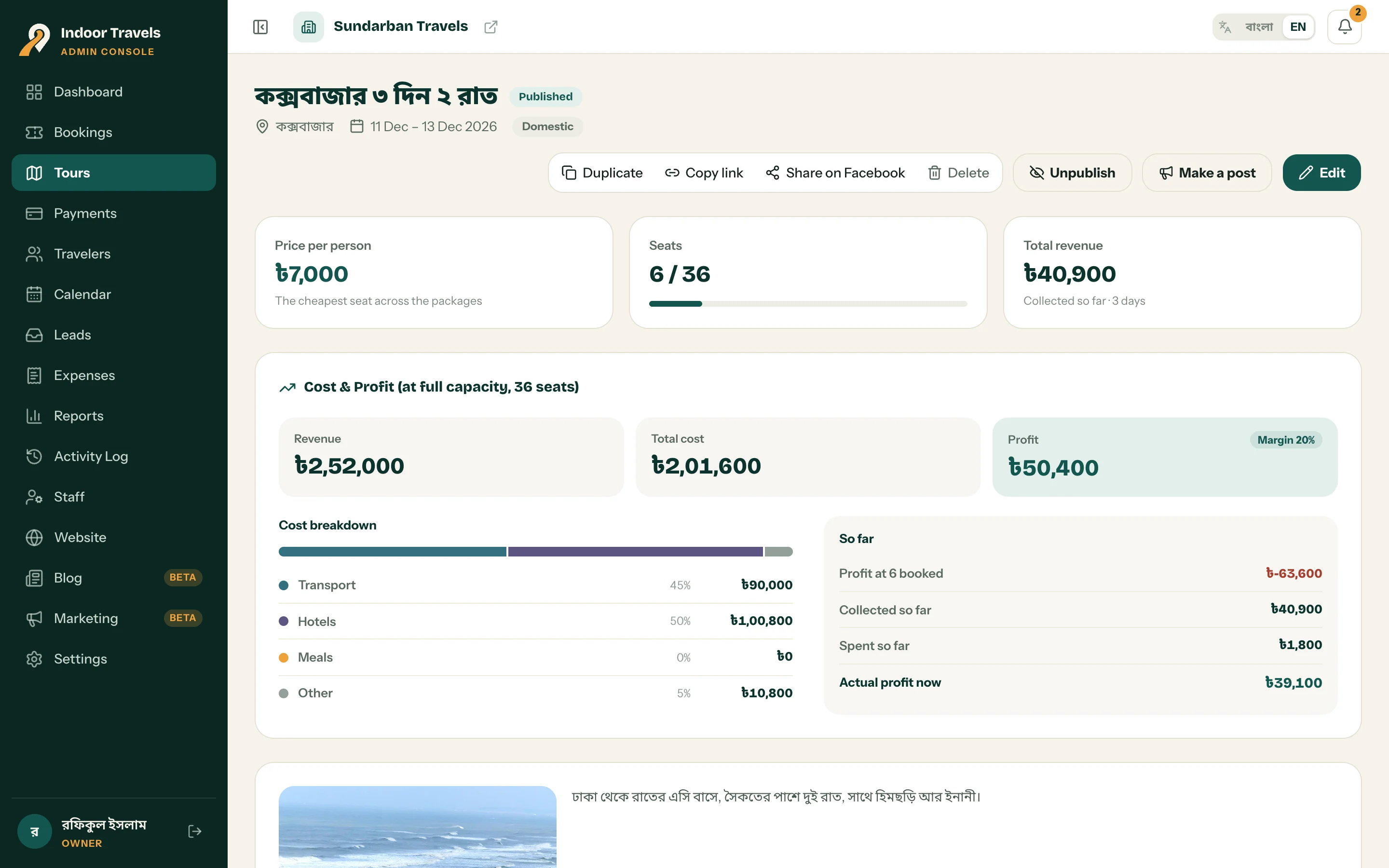
A spreadsheet can do this, but it has to be updated by hand after every booking. In Indoor Travels, you enter the tour's costs and the panel shows the seat that covers them, the profit on the seats sold so far and the profit when full — updated with every booking. See the plans and prices.
Run your agency’s group tours from one panel
A booking website, seat maps, bKash/Nagad advances and the profit of every tour — start on the free plan, no card needed.
Open your agency free